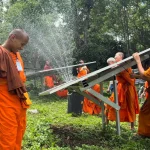
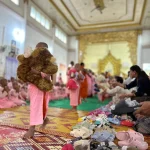
In December, we saw the opening of two academies in Chiang Mai and Mae Sot, a celebration of holistic education.
Riding on the last waves of productivity before the holidays, INEB’s Child Protection Unit (CPU) welcomed our partners from Nairobi, Serbia, and Sri Lanka to Thailand for the opening of the SDG Academies. This has been an ongoing collaborative effort with Arigatou International to explore climate education at the intersection of faith and child rights. It was truly wonderful to see this finally manifest into reality after these couple of years.
Children remain among the most severely affected from the humanitarian crisis produced by Myanmar’s coup escalating conflict. Since the state’s capture in 2021, entire villages have been burned, civilian communities bombarded, and livelihoods systematically destroyed. Many have come to Thailand to seek refuge from this brutality and widespread repression. The CPU’s aim is ensure their stability and security, as they continue to face marginalisation through structural limits within Thailand.
The foundation of SDG Academies is rooted in co-creation with local members and making sure that they are actively involved in shaping the Academy’s activities. In partnership with both Smile-Lay Club and Bodhiyalaya Foundation, we conducted pilot workshops with the aim to introduce the SDGs as a conceptual language to visualise the proximity of issues within their individual and collective lives. This consultation and reflection process then informed the next steps in our journey together.
Empowerment Center with Smile-Lay Club with Muslim and Christian participants
in Mae Sot, Tak province // 6-7 December, 2025

The programme began with the official opening in the morning, set in the beautiful natural landscape of Smile-Lay Club’s community garden. They have been growing their own vegetables and fruit as a form of self-subsistence, and as a means of sharing with others in their community, often preparing meals for the novice monks in the local area. After the celebration, we began a set of participatory workshops, which were conducted over the next couple of days. Our Serbian guests, from the school of Good Will in Sombor, facilitated a guided mini-meditation, setting a contemplative tone and asking the participants to visualise what a peaceful and green world would look like.
Drawing on Brofenbrenner’s Ecological Systems Theory, participants were given worksheets with the micro (the individual at the centre), exo (community) and macro (customs, laws) to use as proximity identifiers for a need, an issue and its solution. This has been a great starting point to then connect to SDG themes and enable conversations around interdependence between person and environment, psychosocial aspects and structural conditions which shape the individual’s experience.

Thank you to Smile-Lay for sharing their wisdom, and their delicious homegrown veggies!
The second day focused more on self-care through nature and each other. Interaction with the environment around us can give a great sense of grounding, connectedness and helps the nervous system to regulate in tune with the natural atmosphere.
They reflected on the limitations of being able to relax, given the difficult situations faced this year and before. Many practiced the mindful breathing from the prior day, as they shared the activity together, creating a sense of presence in the here while exploring these challenging and complex emotions. Participants explored breath as an identifying tool, for the psychological inner state but also for peace, as each exhale is a process of letting go. Later on, with the facilitation of Opor, the participants connected well-being with social justice, recognising that experiences such as lack of access to health services and education are structural conditions. There was a beautiful sense of connection and cohesion amongst the group, as they embraced at the end of the session, thanking one another for their presence and support.
One reflection from a participant:
“The mindfulness session was deeply relaxing, particularly because it enabled awareness and presence without language barriers. The activity created a safe and calming space that allowed participants to gently reconnect with past experiences, including feelings of sadness and worry”. He emphasised that “The ability to speak about such experiences reflects inner strength, difficult memories can be revisited only when one feels sufficiently resourced and supported to process and move beyond them”.

Wisdom Center with novice monks at Doi Saket Phadungsasana School
in Chiang Mai // 9-10 December, 2025

Temples and Buddhist faith leaders have been incredible sources of care for those leaving Myanmar, we are grateful to Bodhiyalaya Foundation for sharing in our collective vision and demonstrating compassion in action. Doi Saket Phadunsasana is a part of their larger learning centre network, host to over 2000 boy novices from over 40 temples, many from conflict areas and the ethnic states within Myanmar. Due to the lack of protective policies at a state level for children on the move, monks have offered the boys a way to access health and education.
The day before the opening ceremony, our wonderful interns from the U.S, Alura and Jenaya, alongside CPU’s regular staff conducted an SDG pilot workshop in a similar fashion. The novices showed great enthusiasm for the activities and demonstrated an already solid baseline understanding of climate change and the related issues. The novices offered a rare opportunity to analyse the SDGs through a Buddhist lens, with brief discussions on Buddhist principles as a means of cultivating an “inner ecology” through which we interact with the world. This was a strong beginning for the SDG Academy in Doi Saket, both staff and children left feeling enthused and hopeful for the journey ahead together.
Throughout the process with both groups in Mae Sot and Chiang Mai, discussions highlighted mental health (SDG 3), nutrition and food security (SDG 2), environmental damage and public health (SDG 13) and education, including legal knowledge (SDG 4) as primary concerns. These findings are not surprising, however they highlight the necessity for multilateral collaboration and tackling of root issues – for e.g. food insecurity is a symptom of disrupted livelihoods and displacement. Without looking at national policy that excludes migrants from protective rights systems, they will continue to face structural conditions foreclosed in precarity and uncertainty.
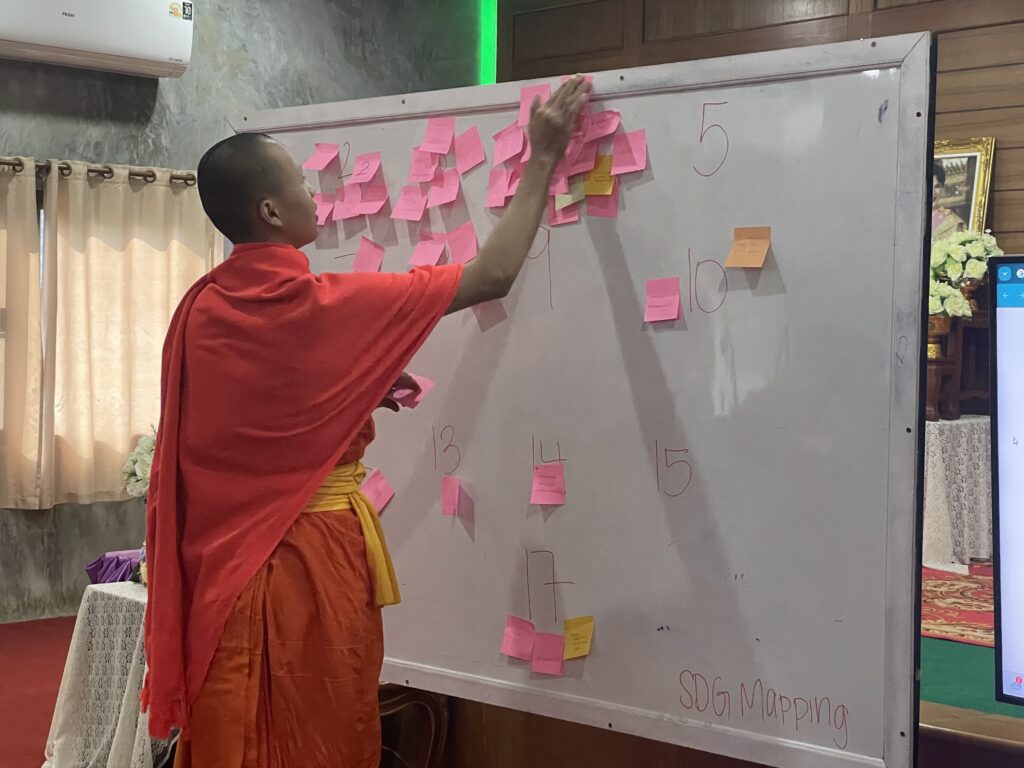
In these workshops, we focused on the SDGs as a language and knowledge framework, without too much emphasis on achieving them as goals. Too often are they misused as simply as an agenda, which limits local knowledge and input. Storytelling, discussion around needs and priorities, these are all ways to localise the SDGs as a real experience and opens up the opportunity to look at solution-focused action as a direct response to the wishes of the relevant community. In the case of Smile-Lay Club, we can see that they are already working towards securing their own nutrition, not because it’s a goal set by regional standards, but as a direct response to the collective need and challenges they face within the community.
Thank you to our partners, Arigatou International, Bodhiyalaya Foundation, Smiley-Lay Club, and all who shared in the joy and hope for imaging a different world. We look forward to what will create in the future.
If you would like to find out more about CPU’s activities, you can visit our main page and if you would like to help directly support us, click here.
Written by Georgina Crouch // Media and Advocacy Officer at INEB’s CPU