24–30 July 2026 | Bangkok & Wongsanit Ashram, Thailand
Writing and photos by Soe San
There are programs that teach us new knowledge, and there are journeys that quietly transform the way we see ourselves, others, and the world. Bodhisattva in Crisis: Learning to Build an Inclusive Society was one of those rare journeys.
Organized by the International Network of Engaged Buddhists (INEB) as a reverse exchange program with Buddhist Hongshi College, the program brought together young people from Taiwan with gender activists, practitioners, and facilitators in Thailand. Over six days, we explored what Engaged Buddhism means when it is lived—not simply studied. Rather than remaining in classrooms discussing theories, participants entered communities, listened to lived experiences, reflected on their own assumptions, and practiced being fully present with one another.
As one of the facilitators, I realized that the most important learning did not begin with social issues. It began with ourselves.
During our opening community-building sessions, participants were invited to practice deep listening and speak honestly about who they are, their fears, their hopes, and the struggles they carry. Many conversations were emotional. Some participants spoke about loneliness, identity, activism, family expectations, and uncertainty about the future. Others simply discovered how rare it is to be listened to without interruption or judgment.

Before trying to change society, we first experienced what it means to create a compassionate community.
One insight that stayed with us throughout the week emerged during our morning reflection at Wongsanit Ashram. One participant shared that transformation requires balance between three interconnected dimensions: the inner self, spiritual practice, and social structures. Looking only inward can become an escape from the suffering of society. Focusing only on activism without inner cultivation eventually leads to exhaustion and burnout. Concentrating only on changing systems without compassion can reproduce the very violence we seek to overcome. These three dimensions must continually nourish one another.
When our inner life is grounded, our social engagement becomes more sustainable.
This understanding became even clearer during Hua Boonyapisomparn’s Power Analysis workshop. Participants examined how power operates within institutions, communities, and even within ourselves. The workshop challenged us to recognize privilege, structural inequality, and the invisible systems that shape people’s lives. Yet it also reminded us that awareness without compassion can become another form of domination. Social transformation requires both critical analysis and deep humanity.
The learning continued beyond meeting rooms.
Our visit to the Mirror Foundation revealed how compassion becomes practical service for marginalized communities. At Wongsanit Ashram, participants encountered an entirely different understanding of sustainability. Rather than viewing ecology merely as environmental conservation, they experienced a way of life where food, housing, education, spirituality, and community exist as one integrated ecosystem. The Ashram itself was built as a sanctuary where activists could rest, reconnect with nature, and restore their spirits before returning to serve society. Over four decades, it has quietly become a place of healing and alternative education for countless young people and social practitioners.
The journey reached its deepest point during our dialogue with Ajahn Sulak Sivaraksa.
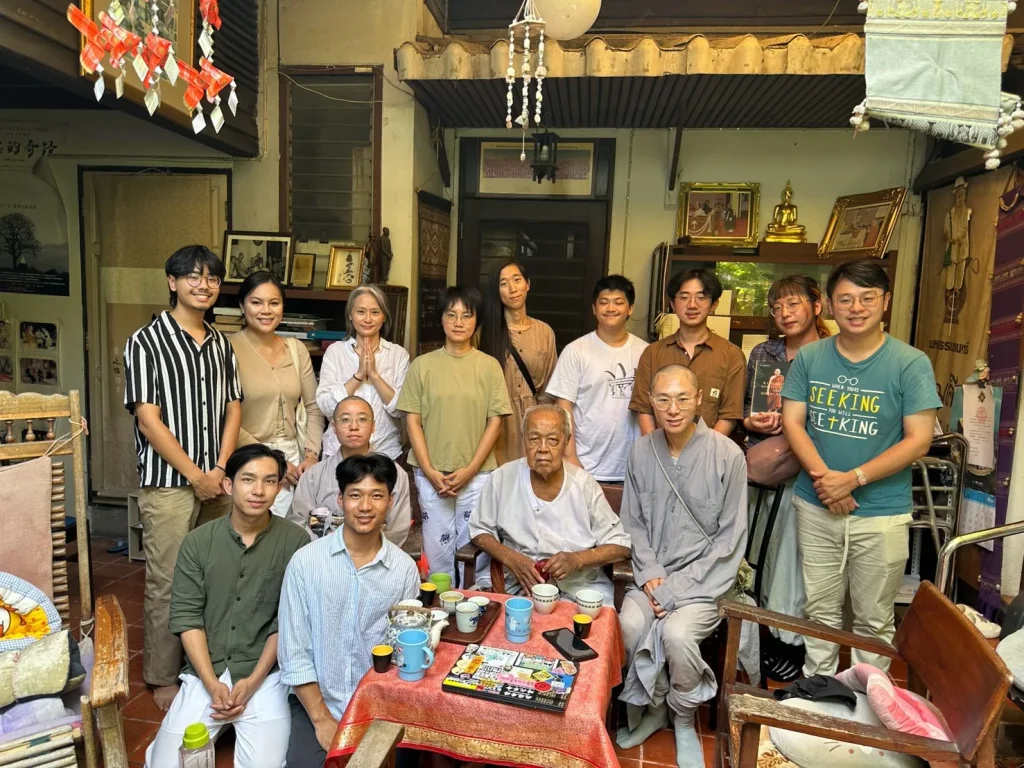
At ninety-four years old, Ajahn Sulak continues to embody fearless compassion. Rather than offering abstract teachings, he spoke from decades of lived experience—challenging injustice while remaining rooted in humility and friendship. He reminded participants that real social change does not begin with power or ideology but with kalyāṇamitta—spiritual friendship grounded in trust, honesty, and mutual care. Without authentic relationships, movements eventually become institutions that lose their heart.
Ajahn Sulak also reminded us that Buddhism is not about escaping the world but entering it more compassionately. A Bodhisattva is not someone who waits until becoming perfect before serving others. A Bodhisattva responds to suffering now, while continuing to learn, question, and transform themselves. Courage without compassion becomes aggression. Compassion without wisdom becomes sentimentality. The Bodhisattva path requires both.
Looking back, I realise this program was never simply about gender justice, ecology, or engaged Buddhism.
It was about learning how to become more fully human.
In a world increasingly marked by polarisation, violence, ecological collapse, and isolation, perhaps the greatest practice of a Bodhisattva is not to have all the answers, but to remain open—to listen deeply, to walk humbly with others, and to continue cultivating compassion that becomes action.
The crisis of our world is ultimately a crisis of relationships.
And perhaps the Bodhisattva path begins by restoring them—one conversation, one community, and one act of compassion at a time.