A1: Phra Ajaan, the venerable teacher, invited me on a trip to Kengtung. There are two seats left—shall we go?
A2: Wowww… go, go! An opportunity has come knocking on our door!
I felt both excited and anxious because everything had to be prepared in such a short time. There were still many responsibilities at work, and yet when the time came, everything seemed to flow naturally. This trip brought together monks and lay participants from diverse regions and roles – 41 monks and people in total. That diversity became both the colour and the most important lesson throughout the journey.
Day 1
We gathered at the Mae Sai District Office to process border-crossing documents into Shan State, one of the major cities of the ancient Lanna Kingdom. We passed through towns familiar from the pages of history – Muang Ko, Muang Len, Muang Tha Duea, Muang Phayak – before crossing the bridge over the Mae Sai River, a small stream that later became a national boundary.
The atmosphere on both sides of the river felt more like visiting relatives than traveling to a “foreign country.” People moved back and forth naturally, it was simply everyday life, except that we had to register our entry and exit in a system created later by national borders. And just like that, we were officially “abroad.”
Upon entering the Shan State, we arrive at an economic hub city – modern, lively, and bustling with transport, trade, exchange, buying and selling, and a blend of cultures. There were also beautiful temples filled with strong faith that sustains the people. It was a visual delight, awakening excitement in my heart at being in a “foreign country,” even though the lands of the two nations are connected, separated only by the small Mae Sai River. Still, each side remains its own homeland, mutually supporting one another.
From there, we continued on our way to Kengtung. The journey unfolded through breathtaking natural landscapes: wide rice fields, layered mountains, roads half concrete and half dirt, rivers and streams, and ethnic villages along the way. The rural atmosphere evoked memories of provincial life in childhood – simple, unadorned, and honest.
Upon arrival at our destination, we went up to Doi Pang Kwai to visit the sacred Buddhist site there, paying homage at the Four Holy Sites. We traveled all day – sightseeing, paying respects, and learning. Though the day-long journey left us physically tired, our hearts were full. When night fell, it was time to eat, rest, and regain strength for the next day.
Day 2
On the morning of the second day, all of us walked through Kengtung’s morning market. Wow… it was incredibly lively! A mix of vegetables, seasonal produce, flowers of many kinds, Tai Yai-style foods, both rice dishes and noodles, cooked on clay stoves fueled by firewood. We prepared lunch to share with fellow travelers and the monks, as the day’s route would take us far from the city, where food was not easily available like back home. Then we set off for Muang Nung.
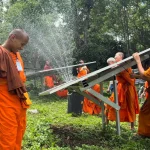
The road itself became another lesson in life – built entirely by human labor: stones hammered by hand, sand spread manually, fires lit to boil asphalt. These scenes appeared repeatedly. The road hugged the mountainside, overlooking rivers below.
We noticed villagers doing something along the riverbanks, but it was not fishing. When we asked the guide, she said they were panning for gold. No wonder the river water wasn’t clear; it was yellowish-red all along the way. There is a gold mine upstream.
Another striking sight was the terraced rice fields. If we imagined them during the green season, they must be incredibly beautiful. The craftsmanship of shaping rice paddies to fit the terrain was remarkable. We also saw herds of cows and buffaloes. We laughed, saying that we have these at home too – fields, cows, buffaloes – but when we become travelers, we still can’t help admiring them. Looking up at the mountains – so high, so steep – sometimes made us feel dizzy with fear, as the road hugged the edge so closely. And of course, during the journey, there were moments when we desperately needed a bathroom. The guide said, “Just a little further.” That “little further” turned out to be two hours! Eventually, we stopped at a rest point to eat, shop, and take a break. By the time we arrived, it was already time for lunch.
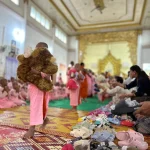
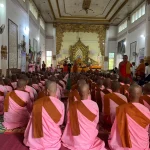
The purpose of this visit was to study Buddhist education and culture in Muang Nung. We paid homage to Phra Chao Inthan, an ancient and highly revered Buddha image believed to be very sacred. We participated in a seminar with the network on Buddhist education and culture in the village, visited old temples, and explored the surrounding natural environment and the local life.
After that, we hurried back to Kengtung because the intercity checkpoints close before 5 p.m. In the evening, we enjoyed the atmosphere around Nong Tung, found something good to eat, and soaked in the night vibes before returning to our accommodation to rest for the next day.
Day 3
On the morning of the third day, I couldn’t resist visiting the morning market again to buy ingredients and food to bring back for the mae chi (nuns). We had to move quickly because of a scheduled seminar on Buddhist education and culture in Kengtung. We also visited the city’s sacred trees at Chom Mon and paid respects at Phra That Chom Kham, the most important stupa of Kengtung. Then we continued with cultural exploration – people, villages, society, and the environment – freely, until night fell on our final evening in Kengtung.
I would like to sincerely thank everyone who joined this Kengtung trip:
- The Sangha from Chiang Mai, Mae Hong Son, Phayao, Chiang Rai, Lamphun, and Lampang
- The Northern Monk Development Network
- Monks teaching moral education in schools
- Volunteer monk graduates working in highland development
- Bodhiyalai Learning Center
- Buddhist Scripture Schools
- Administrative committees of monk teachers
- Kengtung Sangha Network
- Academic Office, MCU Chiang Mai Campus
- Graduate School, MCU Chiang Mai Campus
The diversity of fellow travelers gave rise to many questions:
Why are the roads like this? Where are the hospitals? Where are the schools? Why aren’t children attending school? Why are the temples so beautiful while the communities remain poor?
Language, culture, beliefs, education, and the complex realities of life.
These questions may not have short answers. But seeing, experiencing, and listening is the beginning of understanding. It reminds us that even though borders may stretch far apart, the heart of education and Buddhism is always deeply connected.
Written by Supranee ‘Eiw’ Kanthachai // Project Coordinator