A Life Devoted to Thailand’s Most Vulnerable Children
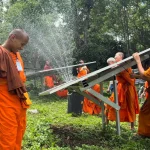
At 4:30 every morning, Bhikkhuni Suthasinee Noi-in comes out of her kuti and starts watering the plants.
By 5:00 a.m., she is walking barefoot toward the local market on her daily alms round. Community members and market vendors wait quietly to make food offerings—relationships that have been built and sustained over many years. Bhikkhuni Suthasinee always checks on elderly sellers, asking about their health. One morning, a woman mentioned persistent headaches. The next day, the Bhikkhuni returned with a jar of balm. She even performed CPR in the middle of the market once.
Compassion, here, is not an abstract ideal. It is daily, practical, and unwavering.
For more than 30 years, Bhikkhuni Suthasinee has dedicated her life to children who had nowhere else to go.
A Home for Children No One Else Would Raise
Home Hug Care began when Ms. Suthasinee Noi-in (then a lay person) used all of her inheritance to purchase 16 acres of land and began caring for infants born with HIV—many abandoned at birth during the height of the AIDS crisis. Doctors warned that most would not survive long.
In the past three decades, more than 1,000 children have died peacefully in her arms, cared for by devoted staff who became their non-biological mothers. Today, about 60 children live on the property, and another 20 young adults—raised at Home Hug Care—are studying or working outside the home.
The children who live there now include:
- Children living with HIV
- Survivors of sexual abuse
- Autistic children
- Children with significant physical and intellectual disabilities
Home Hug Care, a registered charitable foundation called the Suthasinee Noi-in Foundation, is not an orphanage. It is a permanent family home. There are no age limits and no expiration dates. Children grow up here, attend school, pursue higher education when possible, and often return to help care for younger ones. Some of today’s teachers were themselves raised here from infancy.
Every child knows: this is home for life.
Daily Life: Discipline, Dignity, and Belonging
Each morning, while the Bhikkhuni collects alms, children sweep the grounds, clearing leaves beneath tall trees. After breakfast and prescribed medications, they are transported to local schools in the foundation’s vans.
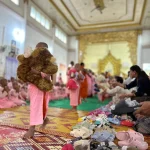
On Sundays and Buddhist holidays, children from the foundation’s four small residential homes—each designed to support different medical and emotional needs—gather in the Buddha hall. Ranging from infants to young adults, they sit together in meditation and chanting. Bhikkhuni Suthasinee keeps rhythm with a wooden percussion instrument and later checks in with each child—asking about school, exams, and personal struggles.
Creative activities are encouraged. During my visit, the children organized a thank-you ceremony for guests. Wearing costumes, they performed on stage and then tied white blessing strings around our wrists—a Northeastern Thai tradition symbolizing gratitude and protection.
Even children with severe disabilities participated. Some took longer to tie the strings. No one rushed them. No one looked impatient.
The message is clear: every child here has worth.
One of the most moving moments of my visit came when a young boy insisted on carrying my dishes to wash. Later, Bhikkhuni Suthasinee shared that he had once been found as a newborn wrapped in a black plastic bag in a garbage bin.
It was impossible to reconcile that beginning with the brightness and gentleness in his face.
The Constant Challenge: Health
Healthcare is both the highest priority and the greatest burden at Home Hug Care.
Many children were born with HIV and have compromised immune systems. Even minor illnesses require immediate intervention.
During my stay, a 12-year-old girl developed a high fever and was immediately isolated near the Bhikkhuni’s quarters. Only she maintained close contact. When the fever persisted, they went to the hospital. A swab test confirmed influenza type A.
Strict isolation protocols prevented further spread. Only two cases occurred.
Food safety is equally rigorous. Meals must be freshly cooked and served hot. Utensils are carefully sanitized. Most prepared foods collected during alms rounds are not served to the children but instead fed to friendly pigs on the property, due to safety concerns. Fresh produce and eggs are used for controlled meal preparation.
These measures require discipline, vigilance, and significant financial resources. All medical expenses are covered by the foundation.
Protection is constant and uncompromising.


Privacy and Protection Above Publicity
Unlike many charitable institutions, Home Hug Care does not accept government funding. Regulatory inspections and exposure could compromise the sanctuary-like environment the children depend on.
For survivors of sexual violence and children with severe disabilities, privacy is not optional—it is protection.
The foundation also limits publicity and strictly guards children’s identities. Dignity always comes before visibility.
A Different Model of Care
Fundraising happens in unconventional ways. Once or twice a year, Bhikkhuni Suthasinee organizes long-distance bicycle rides—often joined by cancer patients and survivors, including the Bhikkhuni herself. Cyclists travel eight hundred kilometers over eight days, ending their journey at Home Hug Care, where children greet them with gratitude ceremonies.
It is not simply fundraising. It is community.
More Than Shelter — A Lifelong Promise
Home Hug Care is not defined by tragedy, though many children arrived through it. It is defined by stability.
It is a place where abandoned infants become university students.
Where children with disabilities perform on stage.
Where survivors of trauma learn to meditate in silence.
Where young adults return because it is still home.
Above all, it is a place built on an uncompromising belief:
Every child deserves dignity.
Every child deserves protection.
Every child deserves a family that does not give up.
And at Home Hug Care, they have one.
Report submitted by INEB Program Director
Visit Dates: January 15–17, 2026