Written by Linus Dolfini, November 2025
Executive Summary
From October 22 to November 3, 2025, the International Network of Engaged Buddhists (INEB) in collaboration with Buddhist Hongshi College conducted the International Young Boddhisattva Program (IYBP) on the campus of Hongshi College in Taoyuan, Taiwan. The program was facilitated by three staff members from the INEB secretariat in Bangkok as well as two members of the INEB executive committee. In total we hosted 29 participants from 17 different countries.
The program’s purpose was to provide the participants with analytical tools, practical knowledge, and access to a network to support them in their development so that they can become the future leaders of their communities.
Our curriculum consisted of workshops, site visits, spiritual practice, and community building activities.
For this two-week journey, we brought together a diverse group of lay people and monastics from different backgrounds, which allowed us to create a warm and supportive environment where personal experiences could be shared, and the participants could build connections that would last beyond the two weeks of the program.
Through IYBP 2025 a new generation of activists, social workers, and educators was introduced to the INEB network and the work of our members, as well as our understanding and practice of socially engaged Buddhism.

Description of the Program
Concept and Approach
The aim of this program has been to bring together and empower young social leaders, from across the world. Every year we invite up to 30 young people to join us at Hongshi College in Taoyuan and embark on this journey together. IYBP is a space for our participants to develop the capacity, confidence, and commitment to realize their full potential. During the program, they learn from each other’s experiences and develop the ability to recognize and analyze the structural and cultural issues facing our communities today. The goal is to equip all our participants with analytical tools, knowledge, and access to a network that will allow them to continue working towards a more peaceful and sustainable future in an impactful way.
The key concept of the program is Bodhisattva – a person who is on the path to enlightenment. As socially engaged Buddhists, we see a modern-day Bodhisattva as someone who is aware of Dhukka on an individual level, as well as throughout the world. A person who is committed to engage with struggling communities and address the issues they are facing. Our participants get exposed to social initiatives and engagements built on the values of Metta – loving kindness and compassion – in the East Asian and especially Taiwanese context. The program involves intellectual, spiritual, and physical practice and our sessions include panels, discussions, community building activities, and meditation practice. Further, we schedule several site visits for the participants to meet with Buddhist change makers and activists and learn about the opportunities and challenges for socially engaged work in Taiwan.
Selection Procedure
This year the program received a total of 116 applications which is around 50 percent more than the program in 2024. This growing interest shows us that there is a clear demand for such spaces, where socially engaged people can come together and to learn and connect. Furthermore, it shows us how many of our alumni valued our program and their experiences during previous years, since word of mouth about IYBP within the INEB network clearly helped to boost the number of applications.
Each applicant was asked to provide personal details, as well as several short essays where they got the chance to give us an impression of themselves, their backgrounds, their interests and passions, and their worries and hopes regarding the state of the world. Processing this many high-quality applications and selecting 30 people amongst the 116 applicants proved to be very challenging, and we decided to split the application process into two rounds. Firstly, after carefully reading all the applications, we drafted a short list of 45 participants which we invited to meet with us for an online interview. Then based on these interviews, we decided which applicants we wanted to bring to Taiwan.
We were specifically looking for people who displayed open-mindedness and who gave us the impression, that they were ready to share their personal stories. To guarantee the long-term success of the IYBP we needed to be certain that the participants we selected are happy to fully engage and to become an active part of this new network we were trying to create during our two weeks in Taiwan.
IYBP 2025 Schedule
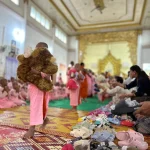
The program was kicked off on October 22 with an opening ceremony in the Grand Buddha Hall at Hongshi College. Both Hongshi founder Venerable Shih Chao-Hwei and INEB founder Sulak Sivaraksa attended the ceremony to share inspiring insights into what it means to be a Bodhisattva in the 21st century. Further attendees were Somboon Chungprampree – the executive secretary of INEB – as well as several INEB Executive Committee members, highlighting the importance of this program for our network.
Throughout the next two days, the program took place on the campus of Hongshi College. We held classes and workshops on power dynamics and social structures to help participants recognize the different backgrounds they each come from and how these shape our lives. Professor Jonathan Watts from Tokyo’s Keio University visited us and spent a day teaching how the Four Noble Truths provide a powerful framework to explore the cultures and structures behind Dhukka and how Buddhist teachings and practices can guide contemporary activism and social transformation.
On October 25, our group visited Tzu Chi Foundation in Taipei, one of the largest humanitarian organizations in the world, which tries to embody the spirit of compassion through their efforts in Taiwan and abroad. On the same day, IYBP joined the youth group of Hongshi College at Taiwan Pride 2025 to stand up for equality and march in solidarity with marginalized communities.
The following day, INEB member KV Soon led a session on Digital Dharma, to discuss how we as engaged Buddhists can apply and make use of rapidly evolving technologies in a mindful way. On October 27, we were invited to Chanfu Hall Shimenshan Labor Recreation Center by Venerable Zinai. She hosted a workshop on how to apply the 10 Paramitas as a tool to work towards collective transformation.
The days after included an introduction to vegetarianism in Taiwan and the art of storytelling in Buddhism, as well as two field trips. Firstly, to Hsuan Chuang University to meet with Taiwanese social, environmental, and gender activists and learn about the work of the different faculties – such as exploring their broadcasting center and their AR and VR projects. Secondly, we visited the Buddha Education Foundation, which continually works to spread Dharma by offering free printing, shipping, and publishing of books on Buddhist topics.
During the last three days of the program, we focused on mindful consumption and ecology and how we can organize activist campaigns in a non-violent way. On our last field trip, we visited two more Taiwanese Buddhist institutions. In the morning we travelled to Dharma Drum Mountain, a spiritual, cultural, and educational foundation dedicated to sharing Buddhist teachings with the wider public. In the afternoon we headed to Dabei Xueyuan, an organization specializing in the end-of-life care. The program concluded on November 3 with a closing ceremony highlighted by cultural performances from the participants, including singing, dancing, poetry recitations, and stand-up comedy.
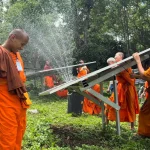
Besides the workshops, classes, and site visits, participants were also given various opportunities to connect with one another through group work, presentations, and physical activities such as cooking or supporting Hongshi by cleaning the campus. The program also allowed participants some free time to explore the sites independently and experience Taiwanese culture at their own pace.

Outcome and Impact
The IYBP is a safe space for learning and sharing, where everyone is welcome, regardless of their heritage, gender, religious beliefs, ethnicity, or sexuality. Upholding this principle is of the utmost importance for us, as it allows us to create a unique program with a group of incredibly diverse participants that are not afraid to be themselves while engaging with each other.
The program was attended by both monks and laypeople from various religious backgrounds, including Buddhism, Hinduism, Catholicism, as well as participants with no religious affiliation. Some came from Europe or North America, while others were born and raised in Asia. Our youngest participants were in their early twenties while others were in their late thirties, and we had a mix across all genders and sexual identities. The different viewpoints that come with different identities were not ignored, the participants met on eyelevel, and nobody was afraid to share their story. This created an incredibly fruitful environment, in which people were allowed to learn from each other’s perspectives and to broaden their understanding.
During these two weeks, the participants were allowed to really get to know each other and to become close friends. The schedule was tight and intensive on most days. And while it could be tiring at times, it also allowed participants to bond closely, as they spent nearly every moment together over the two weeks. The workshops we offered served as a platform for the older generation of INEB to introduce young people to their work, share their experience with them, and inspire them. The field trips and the visits to Taiwanese social institutions helped the participants to create a deeper intercultural understanding and immerse themselves into an unfamiliar context.
Creating an open and culturally diverse space and allowing the participants to grow close to each other is essential for the IYBP, since we want to make sure that the connections, we create last beyond our two weeks in Taiwan. The long-term success of this program comes from introducing young activists and social workers to the INEB network, while helping them to connect with likeminded young people and create their own little network. Through this we help them to become the leaders of the next generation of socially engaged Buddhists and to continue the meaningful work that has been conducted over the past decades.
The Role of Buddhist Hongshi College
The partnership with Buddhist Hongshi College is what allows us to conduct this program every year. Without their support it would not be feasible. INEB budgeted around 10’000 dollars for the salaries of the core facilitators, and the primary contact person in Taiwan, during a period of six months leading up and during the program. Furthermore, this budget covers the honoraria for the guest speakers, and the visa and travel costs of the work team. All costs on the ground are covered by Hongshi College.
Hongshi College offers us a location and the facilities we need to conduct the program in the way that we do. They provide on-campus housing for the participants and the work team, a classroom, and facilities for meditation and extracurricular activities. Furthermore, Hongshi College is committed to providing three meals a day to everyone – even during the site visit days, where they organize food boxes. Hongshi orders tour buses for every field trip and helps us to pick up the participants from the airport and drop them off after the program. Thanks to Hongshi’s generous support, our participants only have to pay the airfare for their travel.
Having Hongshi College as our partner is immensely valuable, because it allows us to invite participants from less privileged backgrounds. Many of the young people who join us each year do not come from wealthy families, and they are students, activists, and social workers. Even collecting enough money for the flight ticket to Taiwan can be challenging and they often rely on private connections or scholarships. It is only thanks to Hongshi that we are able to bring together such a diverse group of participants year after year.
How You Can Support Us
Every year, we face the difficult situation of applicants withdrawing due to financial constraints. Many of them are strong candidates who have already passed our screening process, but due to limited funding we are unable to support their participation. INEB and Hongshi College are not able to offer full scholarships and cover the airfare for our participants. Hence, as of now we can only select participants who can afford the journey by themselves. It is our wish to expand IYBP in the future and make it available to all applicants, regardless of their financial situation.
Therefore, we would warmly welcome any donations with the intent of supporting selected participants with limited means. The beneficiaries of these contributions would be young social workers and activists from across Southeast Asia. People who are committed to contributing to their communities and work towards more justice, equity, and inclusion. Helping them to join this program would give them the opportunity to further grow as people, develop their work, and become part of the IYBP and INEB families.