‘Bahujana Hithaya’ : Living the Dhamma for the Welbeing of All
International Youth Buddhist Fellowship (IYBF) 2027
Organized by Sri Lanka Network of Engaged Buddhists (SriNEB) in collaboration with the International Network of Engaged Buddhists (INEB)
Dates: 8-17 February 2027 [10-day duration]
Location: Three venues in Sri Lanka
Language: English
1. Introduction
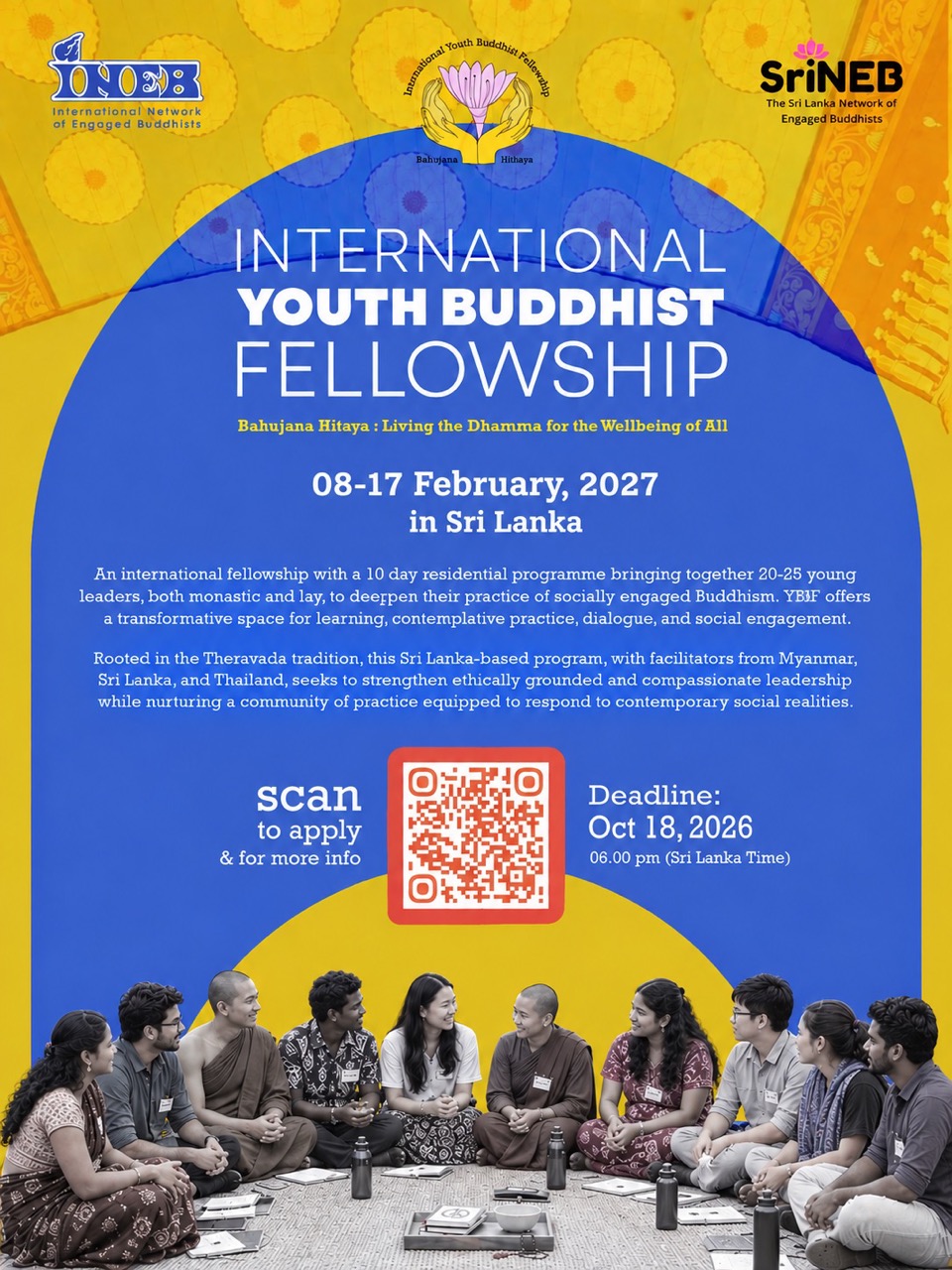
The International Youth Buddhist Fellowship (IYBF) is a fellowship bringing together approximately 20–25 young Buddhists and socially engaged youth leaders both monastic and lay persons from Sri Lanka, Asia and beyond with the primary retreat on 8-17 February 2027 in Sri Lanka.
Organized by SriNEB in collaboration with INEB, the programme creates a transformative space for learning, contemplative practice, dialogue and community engagement with a focus on the theme ‘Bahujana Hithaya’: Living the Dhamma for the Wellbeing of All.
INEB is an international network of Buddhist individuals and organizations committed to peace, justice, sustainability, and compassionate social transformation through engaged Buddhist practice.
SriNEB is the affiliated Sri Lankan network that promotes socially engaged Buddhist thought and practice through dialogue, education, reflection, community engagement, and initiatives that contribute to social justice and healing.
By bringing together participants from different parts of the world, the fellowship encourages rich cross-cultural dialogue on how Buddhist teachings are understood and applied in different societies.
The IYBF program will complement similar youth programs organized by INEB, and hosted in Taiwan and North India respectively inspired by Mahayana and Vajrayana traditions, and will offer a unique experienced rooted within the Theravada tradition and an inclusive approach.
2. Background
Young people today are growing up amid increasing social polarization, conflict, inequality, ecological crises, displacement, mental distress, and uncertainty about the future. While Buddhist traditions offer profound teachings on compassion, interdependence, ethics, and wisdom, many young people have limited opportunities to explore how these teachings can be meaningfully applied to contemporary social realities.
There is therefore a growing need for programmes that:
Connect Buddhist teachings with lived social realities.
Encourage critical reflection rather than theoretical or conceptual learning.
Build relationships across ethnic, religious, national, and cultural differences and transendes identity and power divides.
Develop compassionate and ethically grounded youth leadership.
Inspire practical social engagement rooted in Buddhist values.
IYBF is designed to respond to this need by combining contemplative practice, dialogue, experiential learning, field engagement, and cross-cultural exchange.
3. Objectives
Deepen participants’ understanding of socially engaged Buddhism within a Theravada context.
Explore the relationship between Buddhist teachings and contemporary social challenges.
Foster deep dialogue, mutual understanding, and trust among youth from diverse backgrounds.
Strengthen ethical leadership, compassion, and social responsibility.
Encourage participants to integrate Buddhist teachings into both personal practice and social engagement for the welfare of all (bahujana hitaya).
Build an ongoing international network of young Buddhist practitioners and changemakers.
4. Content Areas
Foundations of Socially Engaged Buddhism
Principles, ethics, compassion, interdependence and ‘Bahujana Hitaya’.
The Human Buddha: Life as a Model for Social Transformation
Exploring the Buddha as a human being whose life demonstrates courage, compassion, ethical leadership, dialogue, inclusion, conflict transformation and service, drawing practical lessons from key episodes in his life.
Identity, Power and Ethical Leadership
Identity, privilege, youth leadership and social responsibility.
Core Buddhist Teachings
Four Noble Truths, Dependent Co-Origination, Four Brahma Viharas and related teachings.
Socially Engaged Buddhism in Practice
Examples from Sri Lanka together with experiences from Myanmar, Thailand, South India and other countries, highlighting diverse applications of Buddhist teachings in peacebuilding, community development, ecology, education and social wellbeing.
Conflict, Peace and Reconciliation in the Sri Lankan Context
A dedicated exploration of Sri Lanka’s experience of conflict, healing, reconciliation, coexistence and peacebuilding through dialogue, field visits and encounters with practitioners.
5. Program Approach and Agenda
Interactive learning and dialogue sessions: Learning through conversation rather than one-way teaching.
Meditation and contemplative practices: Daily mindfulness, reflection, and grounding practices.
Field visits and community immersion: Direct engagement with communities and initiatives.
Reflection circles and peer learning: Shared learning through dialogue and listening.
Story-sharing and practitioner encounters: Learning from lived experience and community leadership.
Collaborative action projects and creative engagement: Including a collective gallery exhibition at the end of the programme.
The international composition of the cohort will create opportunities to compare Buddhist practice and social engagement across Sri Lanka, Myanmar, Thailand, India, and other contexts.
Phase 1: FOUNDATION 8-12 February | Phase 2: IMMERSION AND ENGAGEMENT 12-14 February | Phase 3: INTEGRATION AND GOING FORWARD 14-17 February |
|
|
|
6. Programme and Logistics
The primary ten-day residential programme in Sri Lanka will include community building, thematic learning, field visits, cultural exchange and action planning.
Participants will be required to cover their own costs for travel to Sri Lanka/venue. (including any international airfare). International participants arriving on the programme arrival date (7th February 2027) will be picked up at the airport and dropped to the airport on the programme departure date. (18th February 2027)
Individual participants and/or institutions recommending participants may contribute towards the programme costs in Sri Lanka for accommodation, meals, transport, etc. for themselves and for others, if possible, but this is not a requirement.
The programme’s three phases will be hosted at three venues in the towns of Katana, Kandy and Piliyandala. The centers in Katana and Piliyanda are training centers. The time in Kandy will be Temple Stay at a local Buddhist temple with opportunities to experience life in local temple, engage with local community and conduct ‘shramadana’ (gift of labour) activities with marginalized communities.
Shared accommodation facilities, meals, refreshments and learning materials will be provided throughout the programme. Any materials required for participants to carry with themselves will be communicated in advance.
7. Expected Impact
IYBF will nurture an international network of compassionate young leaders able to apply Buddhist teachings to contemporary challenges while learning from diverse experiences across Asia. With expectations to run the IYBF annually this network of young people and the institutions they are connected to will contribute towards a revival of Socially Engaged Buddhist practices and alleviation of the suffering of the people around the world.
8. Participant Profile
Participants (18–35 years) include students, young monastics, educators, activists, community practitioners and social entrepreneurs with a basic grounding in Buddhist teachings and a commitment to practice, openness and collaborative learning. Young people who fit the participant profile, without any limitation on nationality, religious affiliation, gender or other identity dimensions are welcome to apply.
Be between 18 and 35 years of age.
Have a basic understanding of Buddhist teachings.
Able to communicate effectively in English.
Demonstrate sincere interest in Buddhist practice and ethical living.
Be open to engaging with people from diverse backgrounds.
Agree to observe the Five Precepts (basic Buddist practice discipline) throughout the programme.
Participate actively in a collaborative learning environment.
Commit to ongoing alumni and online learning activities after the fellowship.
9. Application and Selection
You can be part of this fellowship bringing together youth from diverse backgrounds to explore Buddhist values, peace, compassion, social responsibility, and their relevance to today’s interconnected world.
Applications for the inaugural “Bahujana Hithaya” International Youth Buddhist Fellowship in Sri Lanka 2027, will be accepted until 18 October 2026, 06.00 PM Sri Lanka Standard Time (12:3hrs UTC). Young people fitting the participant profile, without any limitation to nationality, faith, or gender, are welcome to apply.
Application link: https://forms.gle/R9AL1xPCqWFsm939A
Application deadline: 18 October 2026, 06.00 PM Sri Lanka Standard Time (12:30hrs UTC)
Interviews for shortlisted applicants: 01-10 November 2026
Selection announcements: 17 November 2026
For any further information: srilankaneb@gmail.com or youth@inebnetwork.org
10. Invitation to Support
We respectfully invite Buddhist institutions, monastic communities, educational institutions, foundations, and individuals who share this vision to join us in making the International Youth Buddhist Fellowship (IYBF) 2027 a meaningful platform for nurturing compassionate, reflective, and socially engaged youth leaders, through one or more of the following:
Sharing experiences and resource persons
Hosting educational visits
Providing venues and accommodation
Sponsoring meals and refreshments
Providing transport
Supplying stationery, printing and learning materials
Supporting audiovisual and programme logistics
Financial sponsorships and participant scholarships
For expressions of interest, partnership, or support:
Sri Lanka Network of Engaged Buddhists (SriNEB)
Mr. Suchith Abeyewickreme, Secretary, SriNEB
suchith.lk@gmail.com | +94770859676